

Preschool Gymnastics (18 Months–4 Years): Why It's Awesome for Confidence + Coordination
Imagine a Saturday morning at the gym, your little one’s eyes are wide, taking in the colorful mats, soft foam shapes, and other tiny humans ready to tumble. There’s laughter, a little nervous energy, and so much excitement buzzing through the air. Your toddler is about to take their first steps (or rolls!) into the world of gymnastics.
If you’ve been wondering whether your 18-month-old or 3-year-old is ready for gymnastics, the answer is a resounding yes. Preschool gymnastics isn’t about creating the next Olympic champion (though hey, who knows!). It’s about giving your child a safe, supportive space to grow stronger, more confident, and better coordinated: all while having an absolute blast.
Let’s dive into why preschool gymnastics is one of the best investments you can make for your little one’s development.
Why 18 Months to 4 Years Is the Perfect Time to Start 🌟
You might be thinking, “My child can barely walk straight: how can they do gymnastics?” Here’s the thing: this age is exactly when their brains and bodies are primed for this kind of learning.
Between 18 months and 4 years, children are experiencing explosive growth in motor development. Their brains are forming millions of neural connections every single day. They’re learning how to control their bodies, understand spatial relationships, and navigate the world around them.
Preschool gymnastics meets them right where they are. Classes are designed specifically for these developmental stages, with age-appropriate activities that challenge without overwhelming. Your child isn’t expected to nail a back handspring: they’re learning foundational movements like jumping, rolling, balancing, and climbing that will serve them for years to come.
Building Confidence One Tiny Triumph at a Time 💪
Every parent cherishes those first moments of pride on their child’s face: the first time they climb to the top of the slide, the first successful somersault, the first time they balance on a beam without holding your hand.
Gymnastics is filled with these moments.
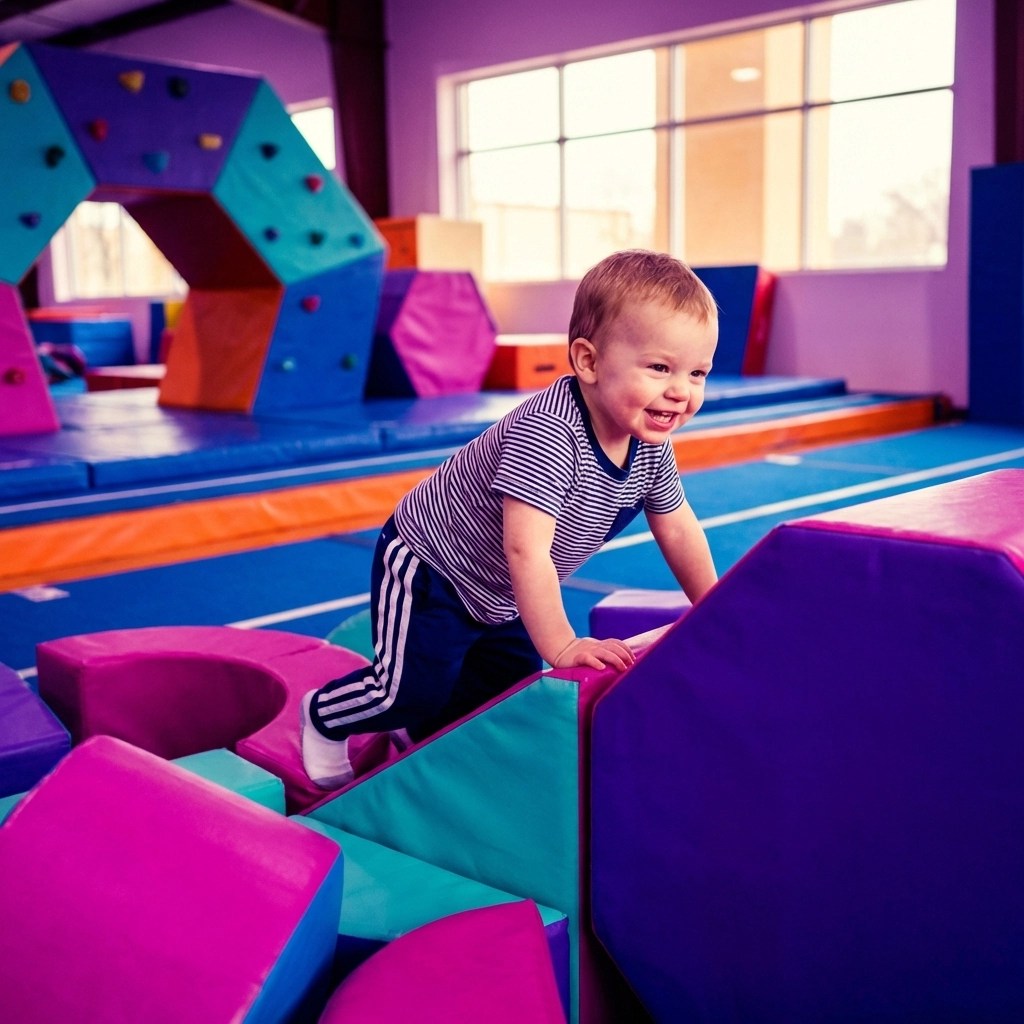
Each small success gives your child a powerful sense of accomplishment. When they master climbing over a foam obstacle, walk across a low beam, or complete a forward roll for the first time, they’re not just learning a physical skill. They’re learning that they can do hard things.
This is where true confidence is built: not from empty praise, but from genuine achievement. As your child overcomes physical challenges in a supportive environment, they develop trust in their own abilities. They become more willing to try new things, take calculated risks, and approach challenges with a “can-do” attitude.
And here’s the beautiful part: this confidence doesn’t stay in the gym. It follows your child everywhere: to preschool, to the playground, to new social situations. Among the greatest gifts gymnastics offers young children is this deep-rooted self-belief that helps them love and value themselves.
From Wobbly Steps to Graceful Moves: Coordination Development 🎯
Let’s be honest: toddlers are adorable, but they’re not exactly known for their grace. Those wobbly walks, tumbling falls, and bumping into furniture are all part of the learning process.
Preschool gymnastics speeds up this coordination development in the most fun way possible.
Through varied exercises and structured activities, children learn crucial alignment skills: how to stand properly, walk with balance, jump and land safely, and move their bodies efficiently. They practice skipping, leaping, running, and balancing: all skills that make their physical world feel more comfortable and manageable.

The result? Your child starts moving with more fluidity and agility. They appear less clumsy and more controlled. Simple daily tasks: like climbing stairs, getting dressed, or playing at the park: become easier because their bodies know how to move with purpose.
This improved coordination isn’t just about looking graceful (though that’s a nice bonus). It’s about safety, too. Children with better body control are less likely to fall and hurt themselves. They’re more aware of their surroundings and better able to navigate physical spaces.
The Brain-Body Connection: More Than Just Physical 🧠
Here’s something that might surprise you: gymnastics is as much a brain workout as it is a body workout.
When your child follows an obstacle course, practices a new skill, or learns a sequence of movements, they’re using both the left and right sides of their brain simultaneously. This builds body awareness, spatial awareness, and cognitive skills that extend far beyond the gym.
Think about what happens when a toddler attempts a forward roll:
- They need to listen to instructions
- They need to remember the steps
- They need to understand cause and effect (if I tuck my chin, I roll)
- They need to coordinate their body to execute the movement
- They need to focus and block out distractions
That’s a lot of brain power for one little somersault!
These cognitive skills: following directions, memory, focus, and problem-solving: are the same skills your child will need when they start school. Preschool gymnastics gives them a head start in the most playful way possible.
Social Skills in a Safe, Structured Setting 👫
For many toddlers, gymnastics class is their first experience in a structured group environment outside the home. And that’s incredibly valuable.
In class, your child learns essential social skills:
- Taking turns – waiting patiently while other children go first
- Listening to instructors – following directions from an adult who isn’t mom or dad
- Sharing space and equipment – learning that the gym belongs to everyone
- Working alongside others – being part of a group activity
- Celebrating others’ achievements – cheering for friends

These skills are the building blocks of emotional intelligence and social competence. When your child eventually enters preschool or kindergarten, they’ll already understand how group settings work. They’ll be more comfortable following routines, respecting authority figures, and interacting with peers.
Plus, there’s something magical about watching your little one make their first gym friends. Those shared giggles and high-fives are the beginning of learning how to build relationships.
A Little “Why Adrenaline?” 💜
You’ve got options for kids’ activities around Littleton: so why do families choose Adrenaline Gymnastics for preschoolers?
- We’re built for little ones – Preschool classes are structured around short attention spans, big curiosity, and safe, age-appropriate progressions.
- Coaches who coach with heart – Our team is all about encouragement, patience, and celebrating the tiny wins that build real confidence.
- A huge, kid-friendly space – With our 21,000-square-foot facility, there’s room to move, explore, and learn without feeling cramped.
- Safety + support come first – Soft surfaces, thoughtful station setups, and clear class structure help your child feel secure while they try new things.
- A mission bigger than skills – We’re here to help your child build a lifelong love of gymnastics through confidence, discipline, and teamwork (even at the preschool level).
What Does a Preschool Gymnastics Class Actually Look Like?
If you’ve never been to a preschool gymnastics class, you might be picturing intense training sessions. Let us put your mind at ease: it’s nothing like that!
Classes for this age group are designed around play. Children move through various stations featuring:
- Soft mats and foam shapes for climbing, jumping, and rolling
- Low balance beams to practice walking and coordination
- Tunnels and obstacle courses for crawling and spatial awareness
- Trampolines and springboards for safe jumping practice
- Bars at appropriate heights for hanging and swinging
- Parachute games and music for group fun and motor skills
Instructors use songs, games, and imagination to keep little ones engaged. One minute they’re “frogs” hopping across lily pads; the next, they’re “airplanes” with arms stretched wide, working on balance.
For the youngest children (typically 18 months to 3 years), classes often include a parent or caregiver on the floor. This provides comfort and security while your child explores. As they grow more independent, they’ll transition to classes where they work directly with instructors.
The Gift That Keeps on Giving
When you enroll your child in preschool gymnastics, you’re not just signing up for a weekly activity. You’re investing in their physical health, emotional development, cognitive growth, and social skills: all wrapped up in one fun-filled hour.
The confidence they build will help them try new things without fear. The coordination they develop will make them stronger, safer, and more capable. The brain-body connections they form will support their learning for years to come. And the social skills they practice will help them thrive in school and beyond.
Every cartwheel, every balance beam walk, every joyful jump is building a foundation for a healthy, happy, confident kid.
Ready to see your little one light up on the mat? At Adrenaline Gymnastics, we love helping Littleton families discover the magic of preschool gymnastics. Our experienced coaches create a warm, encouraging environment where every child can grow at their own pace.
Check out our gymnastics classes in Littleton, CO and find the perfect fit for your tiny tumbler. We can’t wait to meet your family! 🤸♀️